Medical Ethics Quiz Questions With Answers

Medical Ethics Quiz Questions With Answers
Take the quiz now
Go
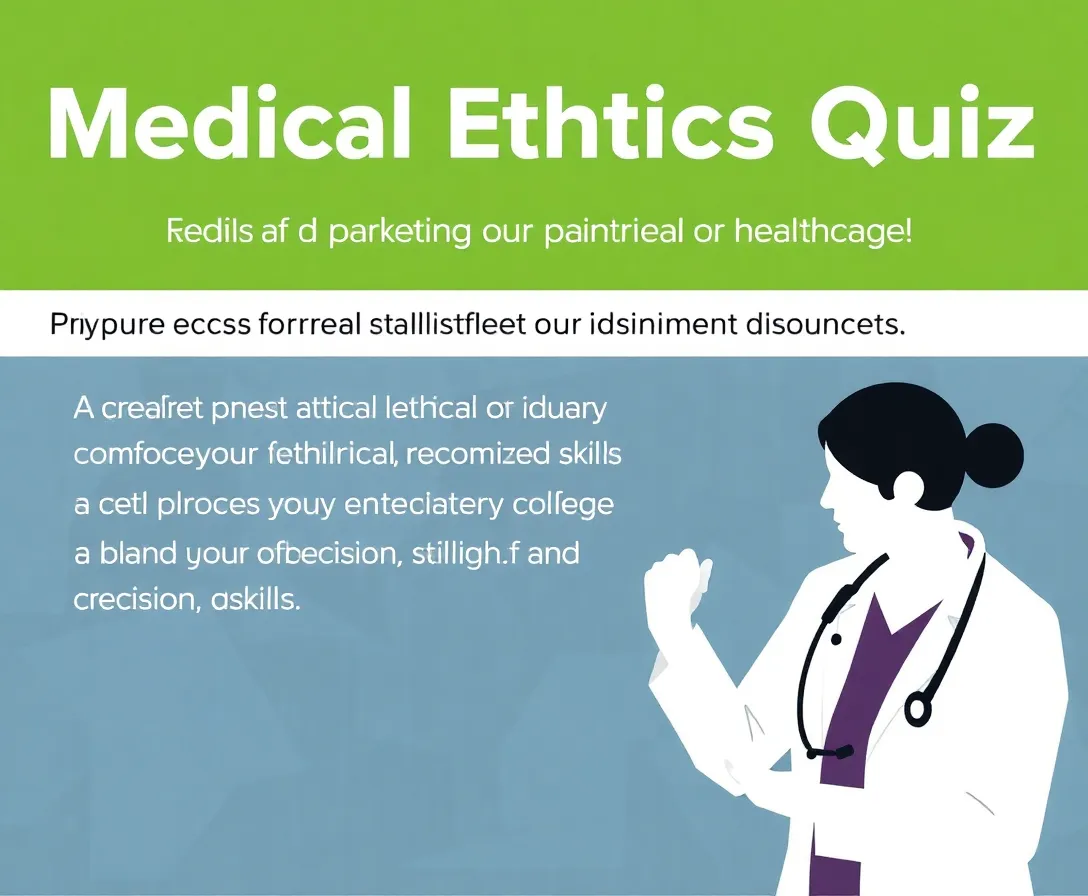
Enhance your grasp of healthcare principles through our Medical Ethics Quiz, crafted to delve into the ethical dilemmas encountered by healthcare professionals. Offering an in-depth analysis of essential ethical principles like autonomy, beneficence, non-maleficence, and justice, this quiz lays a foundational framework for making informed decisions in medical practice. With a diverse set of medical ethics exam questions and answers, you will tackle real-world scenarios revolving around vital subjects such as patient consent, resource allocation, and end-of-life care. The quiz features medical ethics MCQs that illuminate the current challenges and choices influencing the medical arena. This quiz serves as an outstanding resource to bolster your knowledge and critical thinking abilities, reinforcing your comprehension of ethical practices and their repercussions on patient care.

Character Test

1. What is a primary obligation of doctors in modern healthcare?

Promoting health equity
Prioritizing individual autonomy
Ensuring community health
Following established norms

2. Which principle is foundational in avoiding harm to patients?

Non-maleficence
Autonomy
Ecological Responsibility
Rule Adherence

3. Allocating scarce medical resources, like organ transplants, primarily involves which ethical concept?

Justice
Autonomy
Community Wellbeing
Procedural Consistency

4. Which statement about Virtue Ethics is accurate?

It emphasizes community standards.
It focuses on patient choice.
It prioritizes societal needs.
It mandates clear actions.

5. What term best describes the protection of private patient information?

Confidentiality
Autonomy
Public Trust
Standard Procedures

6. Which statement about confidentiality is incorrect?

It must always be protected.
It centers on patient trust.
It sometimes requires harm prevention.
It is exclusive to medical information.

7. All the following are ethics theories except:

Autonomy Theory
Community Theory
Individual Theory
Standard Theory

8. Which is not a true outcome of justice in medical ethics?

Court-ordered actions
Transparent decisions
Fair treatment
Legal compliance

9. Which statement about non-maleficence is not true?

It includes truthful interactions.
It avoids intentional harm.
It values patient consent.
It lacks guidance due to risk.

10. Which statement about patient data access is incorrect?

Information belongs to patients.
Access includes third party data.
Laypersons may misinterpret data.
Sharing reduces accuracy.

11. The focus of virtue ethics is:

On moral character.
Community-based actions.
Consequential results.
Universal rules.

12. An obstacle to maintaining confidentiality is:

Large electronic databases.
Small medical teams.
Patient-based research.
Standard privacy measures.

13. Which of these is not characteristic of consequentialism?

Universal rules
Outcome-focused
Moral action analysis
Efficient outcomes

14. Which principle aligns with 'do no harm'?

Non-maleficence
Autonomy
Social Responsibility
Procedural Norms

15. Socially valuable virtues include:

All of the above
Community engagement
Public trust
Ethical consistency

16. Acting rightly regardless of observation is characteristic of:

Honesty
Power
Community Trust
Rule Following

17. Utilitarian theory helps resolve conflicts between:

True
False
Uncertain
Complex

18. Stopping a harmful medication highlights:

Non-maleficence
Standard Practice
Social Justice
Autonomous Choice

19. Double effect in ethics combines:

Beneficence and Non-maleficence
Autonomy and Community
Social Trust
Standard Compliance

20. Which theory is necessary for industrialized societies?

Teleological theory
Standard Practice
Community Focus
Individual Rights

21. Principles in medical ethics do not include:

Honesty
Social Justice
Power Dynamics
Procedural Norms

22. The essence of autonomy is:

Free decision-making
Confidentiality
Reactiveness
Shared Responsibility

23. Informed consent excludes:

Debates
Understanding
Agreement
Autonomy

24. Actions for harm prevention can be termed:

Beneficent
Community-focused
Data-driven
Protocol-adhering

25. Patient decisions should be based on:

Free will
Full access
Shared Decision
Current Protocol

26. Which principle focuses on patient best interest?

Beneficence
Collective Welfare
Non-maleficence
Standardization

27. Resolving moral disagreement is a weakness of:

Deontological theory
Standard Ethics
Community Focus
Procedural Coherence

28. When can truth-telling be overridden?

Patient preference
Confidentiality breach
Doctor discretion
Permanent harm

29. Not a component of medical ethics:

Ministry relationships
Patient relations
Professional coherence
Society standards

30. Combining strengths of two theories results in:

Teleological theory
Unified method
Collaborative approach
Autonomous practice
Want to Discover Shapes of Life? Try Me.bot
Discover The Unexpected and Find Incredible Inspirations
Loved by Healthcare Professionals Worldwide
This Medical Ethics Quiz is an exceptional resource for understanding healthcare principles. It masterfully covers ethical dilemmas and the core principles of autonomy and beneficence, making it an indispensable tool for informed decision-making in medical practice.
The diverse set of medical ethics exam questions and real-world scenarios in this quiz have greatly enhanced my critical thinking skills. It's a must for anyone involved in patient consent, resource allocation, or end-of-life care decisions.
As a student, this quiz has been a brilliant way to bolster my comprehension of ethical practices. The MCQs are well-crafted and highlight the current challenges in the medical arena, preparing me effectively for future responsibilities.

Frequently Asked Questions

What are the key principles covered in the Medical Ethics Quiz?
The Medical Ethics Quiz covers essential principles such as autonomy, beneficence, non-maleficence, and justice, which are crucial for informed decision-making in healthcare settings.
How can the Medical Ethics Quiz Questions With Answers help healthcare professionals?
Medical Ethics Quiz Questions With Answers aids healthcare professionals by navigating real-world scenarios, thereby improving critical thinking and ethical decision-making skills, which are vital in resolving everyday ethical challenges in medical practice.
What types of topics are explored in the Medical Ethics Quiz?
The Medical Ethics Quiz delves into significant topics like patient consent, resource allocation, and end-of-life care, providing a comprehensive outlook on the ethical dimensions shaping modern healthcare practices.
Why are medical ethics MCQs included in the quiz?
Medical ethics MCQs are included to highlight and explore the current dilemmas and choices healthcare professionals face, allowing quiz-takers to assess and enhance their understanding of complex ethical issues in a structured format.
How can the Medical Ethics Quiz enhance knowledge and critical thinking?
The Medical Ethics Quiz enhances knowledge and critical thinking by engaging participants with challenging questions and scenarios that require them to apply ethical principles and problem-solving skills, thereby enriching their competence in handling ethical matters in healthcare.
Explore All Quiz