Forklift Test

Forklift Test
Take the quiz now
Go
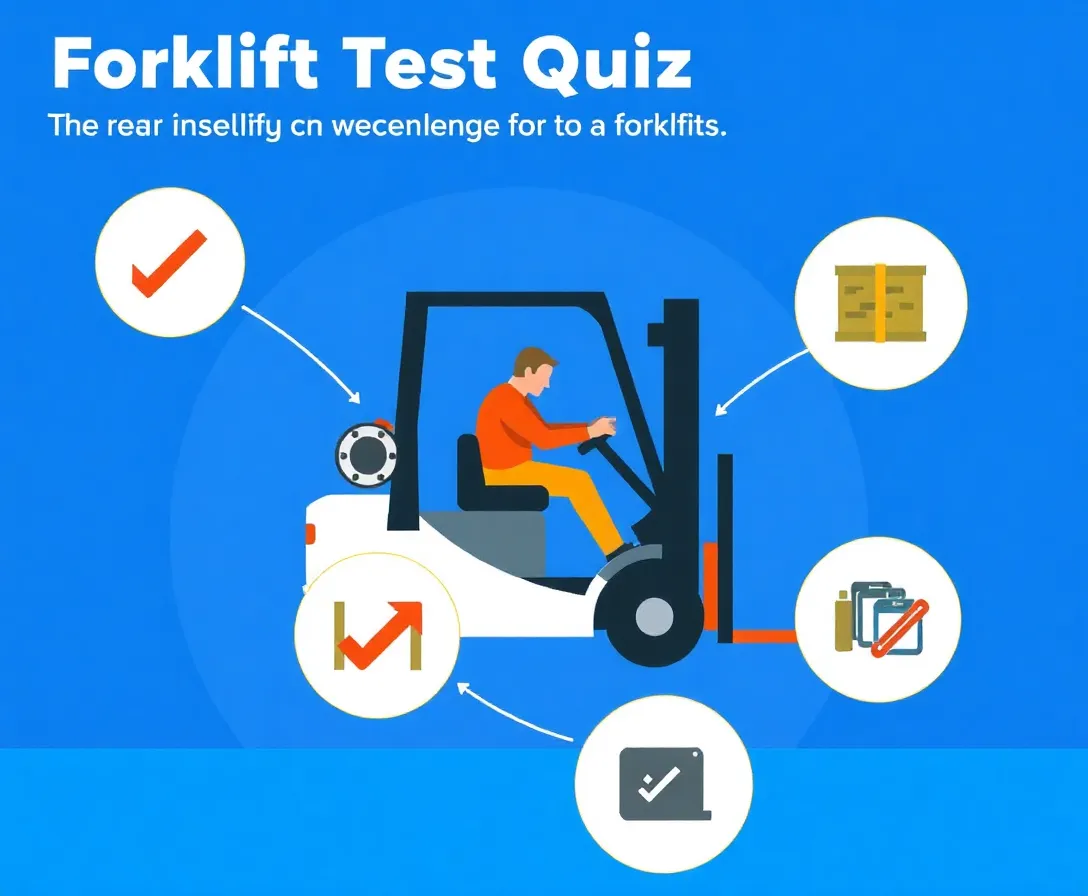
Are you prepared to enhance your forklift knowledge and test your skills? Embark on an exciting journey with our Forklift Test Quiz! This interactive quiz will guide you through different scenarios encountered while operating a forklift, requiring you to make quick, informed decisions. We will provide crucial information to help you succeed. Be ready to answer questions about various forklift types, their components, and functionalities. Can you tell a counterbalance forklift from a reach forklift? Do you know the significance of a mast or the importance of load capacity? Safety is paramount, so fasten your seatbelt, stay focused, and dive into the Forklift Test Quiz adventure!

Character Test

1. When parking or leaving your truck, what should you do to ensure safety?

Park or leave your truck in a designated area.
Lower the forks until they touch the floor.
Turn off the engine and remove the key.
Set the parking brake.

2. When should hard hats be worn on a Fork Lift Truck?

When there's a risk of head injury.
When carrying heavy loads.
When working in confined spaces.
Always.

3. What should the operator always ensure while driving a forklift truck?

To look in the direction of travel.
To keep a distance from pedestrians.
To be aware of load stability.
To check for any obstacles.

4. When can a Fork Lift Operator operate a Lift Truck without a seat belt?

Never.
In low-speed areas.
If the seatbelt is broken.
During loading and unloading.

5. What is the term used to describe the specific stability range of a counterbalance truck?

The stability triangle.
The center of gravity.
Load capacity range.
Balance zone.

6. You have a barrel to locate into racking with a Forklift Truck. What should you do?

Use appropriate lift attachments.
Push the barrel carefully.
Seek guidance from a supervisor.
Use manual handling techniques.

7. When parking a Forklift Truck, you should ensure:

It does not obstruct traffic.
It's near a recharging station.
It's close to your workplace.
It's in a shaded area.

8. When working in a low visibility area or approaching a blind corner, you should:

Beep the horn with three short blasts.
Give a long beep.
Flash the lights.
Shout to alert others.

9. The towbar slot on a Forklift Truck is fitted to:

Allow towing or attachment of equipment.
Attach multiple trailers.
Pull heavy items.
Balance loads.

10. The capacity of a forklift truck is affected by an increase in the load center. The truck can then:

Lift less weight.
Lift heavier loads.
Lift longer loads.
Maintain the same capacity.

11. When traveling, a Forklift Truck should maintain what distance from other vehicles?

At least one truck length.
Two truck lengths.
Three truck lengths.
Six meters.

12. If a fault occurs while you are driving your truck, you should:

Stop and notify your supervisor.
Try to fix it yourself.
Call for assistance.
Continue if it's minor.

13. When raising a heavy load on the Forklift Truck, you should:

Check for overhead obstructions.
Raise it high quickly.
Get assistance for support.
Tilt it slightly forward.

14. When loading a trailer or truck at a loading dock, you should:

Ensure the truck wheels are chocked.
Inform the driver.
Bang the side to signal.
Check the platform edges.

15. The rated capacity of a Forklift Truck is displayed:

On the body on a capacity plate.
Under the bonnet.
On the fork arm.
In the manual.

16. A Forklift Truck is fitted with lights to:

Increase visibility and safety.
Find the truck in blackout.
Operate during a power outage.
Load/unload at night.

17. The load center described on the capacity plate means:

Distance from fork heels to center of balance.
Distance from truck front to load back.
Distance from fork tips to load.
Distance from fork base to truck end.

18. An operator of a Forklift Truck may carry passengers:

Never.
Only in an emergency.
At their discretion.
With supervisor permission.

19. A driver may not lift more than the rated capacity of the truck:

Under any circumstance.
Without authorization.
If it's a short lift.
With counterweight support.

20. When entering or mounting the truck, the operator should gain support from:

The steering wheel and step.
The guard rail and seat.
The wheels and step.
The truck body.

21. The hydraulic system of a forklift truck should be used only when:

The handbrake is engaged.
The vehicle is in forward gear.
The vehicle is in reverse gear.
The weight is balanced.

22. When traveling with a loaded truck on a hill, the fork tips should point:

Uphill.
Downhill.
Varied by load.
Parallel to the slope.

23. A Forklift Truck is at its most dangerous when:

Loaded to capacity.
Loaded below capacity.
Turning.
Unloaded.

24. An operator may lift a person on the forklift when:

In a safety cage.
In an emergency.
Instructed by a manager.
Height is under 10 feet.

25. Watching for the dangers of pedestrians and Fork Trucks is the duty of:

Everyone in the area.
The operator.
The manager.
The pedestrians.

26. Before operating a Fork Truck in the workplace, an operator is required to have Written Authorization issued by:

The employer.
Instructor.
Provider.
HSA.

27. In the Republic of Ireland and the UK, the Lift Truck should be driven in an aisle or gangway:

On the left-hand side.
On the right-hand side.
In the center.
In any direction.

28. A lift truck should be driven at which speed?

Consistent with the load.
Demand of work.
Maximum road speed.
Manufacturer's max speed.

29. The truck should begin the turn when the turning point has:

Cleared the critical point.
Reached before the critical point.
Is directly opposite the critical point.
Moved past the critical point.

30. Pre-use inspection needs to be carried out by the operator:

At the start of the shift.
When signs of power loss.
When instructed by employer.
Once per week.

31. What position should a truck's mast be in to comply with the manufacturer's rated capacity?

Vertical on level ground.
Tilted forward.
Tilted back.
Forks on the ground.

32. When driving an unladen Lift Truck, what position should the fork arms be in?

As low as practicable.
8 inches high.
6 inches high.
Tilted back.

33. When sounding the Lift Truck at a blind corner in the working environment, you should:

Give three short blasts.
Give a long blast.
Flash your lights.
Give a short beep.

34. What position should the fork arms be in to handle metal pallets or stillages?

As wide as possible.
As central as possible.
As close together as possible.
To one side.

35. How does an operator normally approach a stack or rack to retrieve a pallet?

Stop 1 meter away and raise forks.
Stop 6 inches away and raise forks.
Place handbrake, engage neutral.
Move slowly and adjust height.

36. In normal circumstances while operating a Lift Truck, when you cannot see over a load, you should:

Travel in reverse.
Move forward slowly.
Dismount and check.
Get someone to guide.

37. When driving over speed bumps, tracks, or gullies, the operator should:

Travel slowly in a straight line.
Approach diagonally.
Travel quickly.
Move backward.
Want to Discover Shapes of Life? Try Me.bot
Discover The Unexpected and Find Incredible Inspirations

Frequently Asked Questions

What is the Forklift Test?
The Forklift Test is an interactive quiz designed to assess and enhance your knowledge about forklifts, including their types, components, and functionalities.
Why should I take the Forklift Test?
Taking the Forklift Test helps you improve your understanding of forklift operations, ensuring you can make quick and informed decisions in real-life scenarios, prioritizing safety and efficiency.
What topics are covered in the Forklift Test?
The Forklift Test covers various topics such as different types of forklifts, their components, functionalities, the difference between a counterbalance and reach forklift, and the importance of load capacity and safety measures.
How can the Forklift Test help in real-life forklift operation?
The Forklift Test simulates real-life challenges, allowing you to practice decision-making in controlled scenarios. This helps improve your skills and knowledge, making you more adept at handling actual forklift operations.
Is prior forklift experience necessary to take the Forklift Test?
No prior forklift experience is needed to take the Forklift Test. The quiz provides all the necessary information, making it suitable for both beginners and experienced operators who wish to refresh their knowledge and skills.
Explore All Quiz