Anatomy Of Facial Muscles Quiz

Anatomy Of Facial Muscles Quiz
Take the quiz now
Go
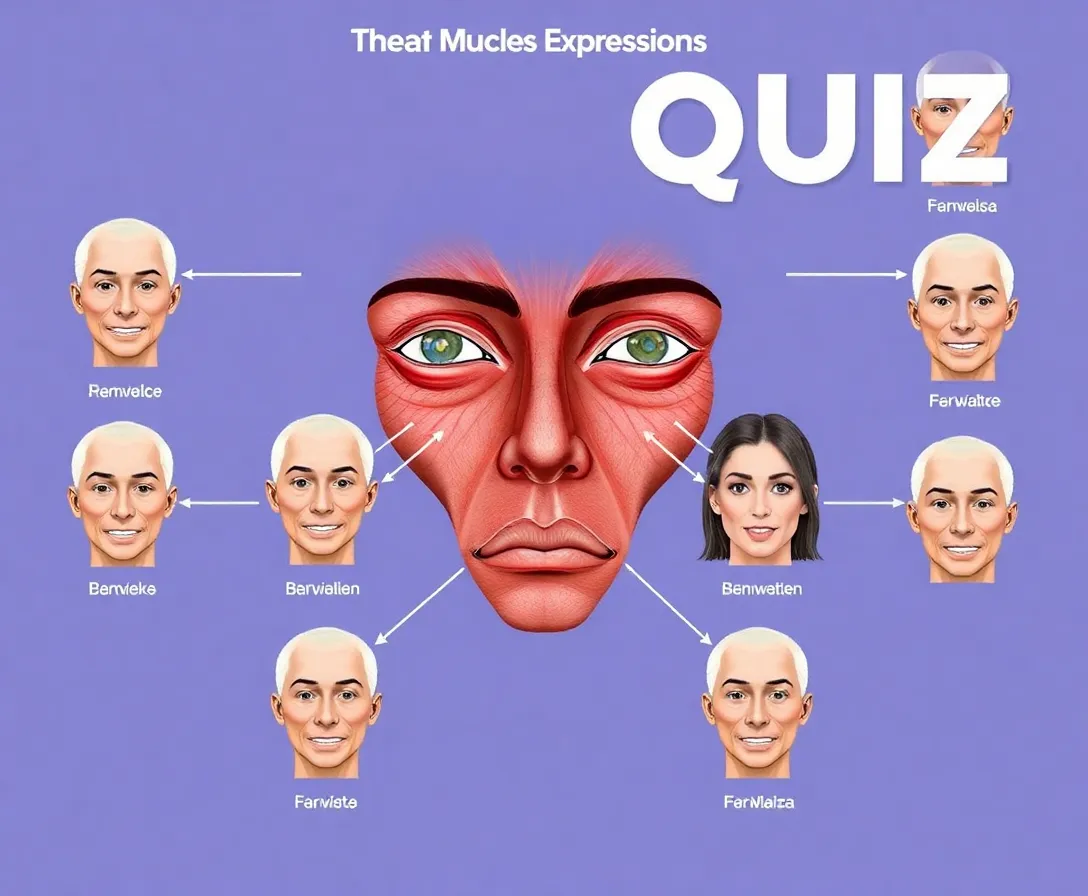
The Anatomy of Facial Muscles Quiz is designed to enhance your understanding of the facial muscles that play a crucial role in social interaction by expressing emotions such as happiness, anger, and sadness. Discover the workings of these muscles as you engage with this quiz, which serves both as a self-assessment and a learning tool. Dive into the complexities of facial expressions by exploring different muscle groups and their functions. Understand how these muscles synchronize to display emotions and how they are affected by neurological factors. This comprehensive and interactive quiz is perfect for students preparing for exams, medical professionals, or anyone curious about human anatomy who wants to broaden their knowledge of this intriguing subject. Test your skills and deepen your insight into one of the most captivating elements of human anatomy!

Character Test

1. What does the Epicranius - Occipital Belly do?

Draws back scalp, aids in forehead movement.
Tightens and stabilizes scalp muscles.
Assists in ear movement.
None of these

2. Function of the Epicranius - Frontal Belly?

Wrinkles forehead, raises eyebrows.
Assists in closing the mouth.
Aids in ear tension.
None of these

3. What is the role of Temporoparietalis?

Raises eyebrows, tightens scalp.
Assists in scalp movement.
Supports ear elevation.
None of these

4. Auricularis - Anterior function is?

Draws ear forward, helps move scalp.
Aids in ear retraction.
Enhances scalp tension.
None of these

5. Purpose of Auricularis - Superior?

Draws ear upward.
Pulls ear to the side.
Moves scalp.
None of these

6. Auricularis - Posterior helps in?

Drawing ear backward.
Ear elevation.
Enhancing scalp stability.
None of these

7. How does Orbicularis Oculi - Orbital Part function?

Strong eyelid closure.
Gentle eyelid pull.
Supports tear drainage.
None of these

8. Orbicularis Oculi - Palpebral Part is responsible for?

Gentle eyelid closure.
Strong eyelid lift.
Facilitates tear movement.
None of these

9. Role of Orbicularis Oculi - Lacrimal Part?

Assists in tear drainage.
Moderates eyelid tension.
Maintains tear supply.
None of these

10. Function of Corrugator Supercilii?

Draws eyebrows downward.
Lifts eyebrows.
Moves eyebrows laterally.
None of these

11. What does Procerus do?

Wrinkles nose, lowers eyebrows.
Elevates nares.
Distorts mouth shape.
None of these

12. Role of Nasalis?

Maintains nares opening.
Constricts nasal passages.
Smooths nose surface.
None of these

13. Depressor Septi function is?

Controls nares movement.
Modifies nose appearance.
Assists in mouth movement.
None of these

14. Orbicularis Oris helps with?

Closing lips.
Lifting corners of the mouth.
Tightening cheek muscles.
None of these

15. Main function of Levator Labii Superioris?

Elevates upper lip.
Provides cheek tension.
Enlarges nares.
None of these

16. Role of Levator Anguli Oris?

Lifts mouth corners.
Expands smile width.
Draws lips inward.
None of these

17. Zygomaticus Major is responsible for?

Raising angle of the mouth.
Lifting mouth corners slightly.
Lowering mouth angle.
None of these

18. Function of Zygomaticus Minor?

Forms nasolabial lines.
Supports smile formation.
Helps in frown.
None of these

19. What does the Risorius do?

Retracts mouth angle.
Lifts mouth edges.
Moves mouth slightly forward.
None of these

20. Depressor Labii Inferioris helps with?

Lowering bottom lip.
Raising upper lip.
Compressing lips tightly.
None of these

21. Purpose of Depressor Anguli Oris?

Lowers mouth corners.
Lifts jaw slightly.
Draws lips to the side.
None of these

22. Mentalis is used for?

Protruding lower lip.
Smiling widely.
Compressing lips.
None of these

23. How does Buccinator function?

Compresses cheek.
Puffs cheek outward.
Tightens face muscles.
None of these

24. Temporalis is related to?

Mandible retraction.
Eye narrowing.
Jaw relaxation.
None of these

25. Masseter's main function?

Jaw elevation.
Mouth relaxation.
Strengthening cheek.
None of these
Want to Discover Shapes of Life? Try Me.bot
Discover The Unexpected and Find Incredible Inspirations
Loved by Anatomy Enthusiasts
The Anatomy of Facial Muscles Quiz is an incredible tool for understanding facial muscle groups. It enhanced my knowledge and preparation for exams. A must-try for any anatomy enthusiast!
This quiz provides a comprehensive look at the workings of facial muscles. It's impressive how it covers both the synchronization of muscles and their neurological impacts.
I thoroughly enjoyed this quiz on facial muscles. It's interactive and informative, making it perfect for both teaching and personal learning. Highly recommend it to fellow educators!

Frequently Asked Questions

What is the focus of the Anatomy of Facial Muscles Quiz?
The Anatomy of Facial Muscles Quiz concentrates on teaching about the various muscle groups in the face responsible for expressing emotions and how these muscles function together.
Who can benefit from taking the Anatomy of Facial Muscles Quiz?
Students, medical professionals, and anyone interested in human anatomy can benefit from the quiz by advancing their understanding of facial muscle anatomy and its role in emotional expression.
What will participants learn from the Anatomy of Facial Muscles Quiz?
Participants will learn to identify different facial muscle groups, understand their coordination in conveying emotions, and how neurological functions impact these processes.
How does the Anatomy of Facial Muscles Quiz enhance learning?
The quiz offers a comprehensive and interactive learning experience, allowing users to test their knowledge and gain a deeper insight into one of the most interesting aspects of human anatomy.
Why are facial muscles important in human anatomy?
Facial muscles are crucial because they enable humans to express emotions such as happiness, anger, and sadness, playing a vital role in social interactions and communication.
Explore All Quiz