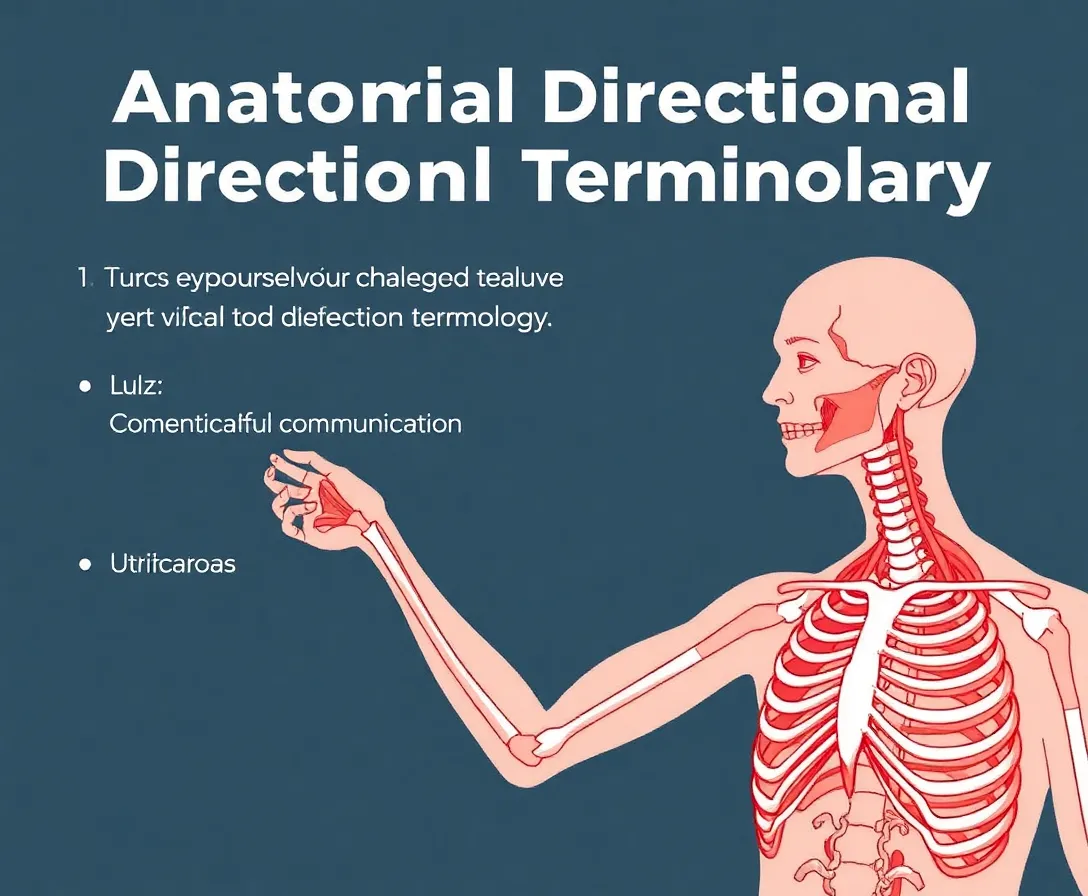
Are you prepared to explore the realm of anatomical terminology? Test your knowledge with our all-encompassing Anatomical Terminology Quiz. This quiz is meticulously designed to assess your comprehension of key anatomical language, directional terms, joint movements, and more. Through a series of stimulating questions, you'll get to demonstrate your understanding of anatomical concepts. From identifying body planes to recognizing precise terms for movements and positions, this quiz tackles it all. Challenge yourself and aim for the top score as you delve into the complexities of anatomical terminology. Whether you're a student or just fascinated by the human body, this quiz will undoubtedly boost your anatomical knowledge. So, give it your best shot and see if you can master the world of anatomical terminology!
1. Which answer best describes the 'Anatomical Position'?
Standing straight, facing the observer, arms at the side, palms facing forward
Standing straight, facing the observer, arms at the side, palms facing inward
Standing straight, facing away from the observer, arms at the side, palms facing forward
Standing straight, facing the observer, arms at the side, palms facing downward
2. Which statement is accurate?
The neck is superior to the pelvis.
The chest is inferior to the abdomen.
The hip is superior to the shoulder.
The ribs are superior to the chin.
3. Mrs. Jones is walking toward you. You are observing her from a (an)_______________view.
Anterior
Posterior
Dorsal
Proximal
4. Which statement is true?
The shoulder is lateral to the neck.
The ankle is medial to the foot.
The knee is lateral to the hip.
The inside of the thigh is lateral to the outside of the thigh.
5. Which statement is correct?
The hip is proximal to the knee.
The knee is proximal to the ankle.
The shoulder is distal to the elbow.
The knee is distal to the hip.
6. Mrs. Smith has poison ivy on her shoulder, poor thing. She reaches her right hand over to her left shoulder to 'scratch that itch.' Which movement is occurring at her ELBOW joint?
Flexion
Extension
Circumduction
Supination
7. Which movement is occurring at Mrs. Smith's right shoulder when she 'scratches that itch'?
Internal Rotation
External Rotation
Circumduction
Lateral Flexion
8. Jane feels compelled to do a few jumping jacks. Which movement is taking place as her hands come together above her head?
Abduction
Lateral Flexion
Internal Rotation
Medial Flexion
9. Jane has completed those jumping jacks. Her hands are now at her side. Which movement did she complete?
Adduction
Abduction
Internal Rotation
Lateral Flexion
10. Tilt your head, bringing your right ear to your right shoulder. What is the movement of your neck?
Lateral Flexion
Rotation
Medial Flexion
External Flexion
11. Mrs. Cicoria is mad at Mr. Cicoria. Her posture is as follows: She is standing with her left foot pointed forward, her right foot is pointed out to the side, her hands are on her hips, and she is tapping her right foot up and down off the floor. Which answer best describes the action of her right HIP joint?
External Rotation
Flexion
Extension
Internal Rotation
12. The reason Mrs. Cicoria is angry is that she held out her right hand, PALM UP, waiting for Mr. Cicoria to give her some cash so that she could go shopping. What best describes this movement?
Supination
Pronation
Adduction
Rotation
13. GI Joe is working on his third set of thirty push-ups. Which best describes the position he is in?
Prone
Supine
Strong
Distal
14. What is the movement of her ankles if she stands on her tiptoe to get her hands on her favorite dish in the cupboard?
Plantar Flexion
Extension
Dorsiflexion
Anterior Rotation
15. Mark is sitting in a chair, legs out in front of him, resting on an ottoman. His knees are:
Flexed
Hyperextended
Rotated
Extended
16. Remember when Mrs. Cicoria was mad, she was tapping her right foot on the floor? Which best describes her ANKLE movement as her foot lifts off the floor in an UPWARD motion?
Dorsiflexion
Plantar Flexion
Inversion
Eversion
17. Tom has just received his new Hoveround! As he prepares to get into his chair safely, he straightens and braces his left arm on the left armrest of the chair. He bends forward to flip up the footplate of the chair. Which movements have occurred at his ELBOW and HIP joints?
Extension of the elbow, flexion of the hip.
Flexion of the elbow, extension of the hip.
Abduction of the elbow, flexion of the hip.
Abduction of the elbow, adduction of the hip.
18. Which BEST describes the action you complete every day when you turn OFF the ignition of your van?
Internal Rotation
External Rotation
Supination
Pronation
19. Jillian is the cutest baby; she is lying in her crib, playing with the toy that is hanging above her. What position is Jillian lying in?
Supine
Prone
Flexed
Extended
20. Which statement is correct?
The elbow is distal to the shoulder.
The ear is medial to the eye.
The chin is anterior to the nose.
The elbow is proximal to the shoulder.
Advertisement
Want to Discover Shapes of Life? Try Me.bot
Discover The Unexpected and Find Incredible Inspirations
Who can benefit from taking the Anatomical Terminology Quiz?
What topics are covered in the Anatomical Terminology Quiz?
How is the Anatomical Terminology Quiz structured?
Why should I take the Anatomical Terminology Quiz?
The Anatomical Terminology Quiz: How Well Do You Know? evaluates your understanding of essential anatomical terms, directional terms, joint movements, and other key concepts in anatomical language.
Both students and those fascinated by the human body can benefit from taking the Anatomical Terminology Quiz: How Well Do You Know? as it enhances knowledge and understanding of anatomical terminology.
The Anatomical Terminology Quiz: How Well Do You Know? covers a wide range of topics including body planes, directional terms, joint movements, and specific anatomical positions.
The Anatomical Terminology Quiz: How Well Do You Know? is composed of a series of thought-provoking questions designed to test your comprehension of various anatomical concepts.
Taking the Anatomical Terminology Quiz: How Well Do You Know? helps you challenge your understanding, improve your anatomical knowledge, and see how well you can navigate through the intricacies of anatomical terminology.